

Dawn through the Year
Posted on Tue, 2006-04-18 22:17 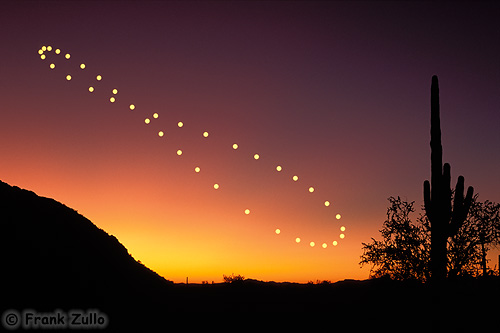 The picture, taken near Ajo, Arizona is a multiple exposure, each shot taken ten days apart, at 8:30 AM for a year. The sun's seasonal shift forms this figure 8, known as the analemma. Because of this effect, sundials can run ahead of clock time by as much as 16 mins 33 secs or fall behind by as much as 14 mins 6 secs.
When I saw this picture, it reminded me of an elderly gentleman named L. Gordon Plummer. He was retired, but volunteered time to come into my sixth grade class and teach us physics once per week. He'd teach us interesting things like basic concepts in relativity and quantum mechanics, or about hyper-cubes (four-dimensional objects). He invented a sundial that is always correct, by incorporating an analemma-shaped object into the design. It's still standing (I think) in Balboa Park in San Diego. I'm sure he's passed on long ago now. He was an interesting person, one that made an impact on me.
2623 reads
Comments
one error
By Anonymous on Fri, 2006-06-23 01:50
> Because of this effect, sundials are inaccurate by amounts as much as an hour throughout the year.
You have overestimated the effect. Sundials are inaccurate up to 17 minutes through the year, and during summer - less than 7 minutes.
Ivan Korolev, ivankorolev@yandex.ru
change
Thanks, Ivan.
According to a Wikipedia article:
During the course of the year, the time as read from a sundial can run ahead of clock time by as much as 16 min 33 s (around October 31–November 1) or fall behind by as much as 14 min 6 s (around February 11–12). This difference, known as the equation of time, results from an apparent irregular movement of the Sun caused by a combination of the obliquity of the Earth's rotation axis and the eccentricity of its orbit. The equation of time is visually illustrated by an analemma.I've changed this blog entry to match.